-
- Perceptual patterning that remain constant or relatively stable over a range of contexts, contents, and/or processes
- The distinctions in experience that make the experience we distinguish
- Colloquially - the filters through which we perceive the world; perceptual filters
- Well formedness conditions for meta-programs
- Each is formed of the simplest possible experiential distinctions: Perceptual Primes
- Each is a different set of distinctions that are independent of all other distinctions
- Each has a neuro-linguistic form
- Internal representational form
- physiology
- language and/or grammatical evidence
Contents
Visualizing Meta-Programs
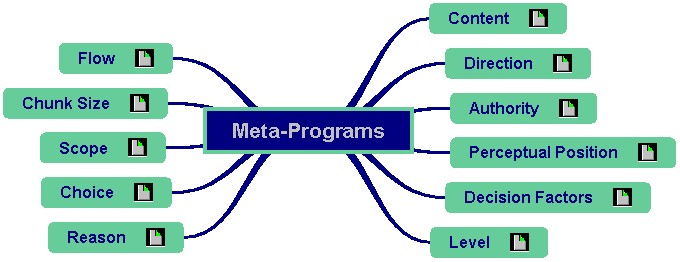
Meta-Programs Elicitation
- Number of utterances/words
- Intensity of expression of the utterance
- Ranking as a sequence of utterances
Meta-Programs & Strategies
Meta-Programs
Content
- People, things, activities, information, place
Direction
- Away from, toward
Authority
- External, internal
Perceptual Position
- Self, other, observer
Decision Factors
- Same, comparison, difference
Level
- Sequential, random
Reason
- Procedures, options
Choice
- Necessity, possibility
Scope
- General, specific
Chunk Size
- Abstractions, details
Flow
- Deduction, induction, abduction
Strategies
Decision
- Function: Selection
- Attention: Choice
- Info Type: Digital
- Content
- People, things, activities, information, place, time
- Perceptual Position
- Self, other, observer
- Attention Direction
- Self, other, observer
- Time Frame
- Past, present, future
- Scope
- General, natural, specific
Motivation
- Function: Engage/Act
- Attention: Energy
- Info Type: Analog
- Neuro-Logical Level
- Values/beliefs/criteria
- Direction
- Toward goals, away from problems
- Level
- Practive: active
- Reactive: considers & waits, passive
- Decision Factors
- Similarity, comparison, difference, polarity responder - "fixed" difference
- Reason
- Precedures, options
Conviction
- Function: Verify
- Attention: Congruence
- Info Type: Reflexive
- Authority
- Self, other, data
- Criterial Evidence
- A see, hear, and feel description of what wil fulfill the criteria
- Representational Systems
- Visual, auditory, kinesthetic
- Evidence Patterning
- Frequency, duration, automatic, never
Memory
- Function: Reference
- Attention: Experience
- Info Type: Access
Creativity
- Function: Generative
- Attention: Alternatives
- Info Type: Meta/All
Learning
- Function: Incorporate
- Attention: Responsiveness
- Info Type: Re-contextualize
Reality
- Function: External/Internal
- Attention: "Real"
- Info Type: Distinctive
The Meta-Programs & Their Distinctions
Categories of Experience
- Representational Systems [D]
- Kinesthetic: ANS-feelings
- Visual
- Kinesthetic: CHS-tactile
- Auditory
- Olfactory/Gustatory
- Content [D]
- People: Who, Relate
- Things: What, Get/Have
- Activities: How, Do
- Information: Why/How, Know
- Place: Where, Be
- Time: When, Be
- Neuro-Logical Levels [D]
- Identity: Be, Who
- Beliefs: Have, Why
- Capabilities: Know, How
- Behavior: Do, What
- Environment: Be, Where/When
Direction
- Direction [A]
- Toward: Positive
- Away From: Negative
- [Against]: Positive
- [Mediation]: Negative
- Neurology [A]
- Stimulation (Toward [Against])
- Relaxation (Away From [Mediation])
- Active [A]
- Active
- Passive
- Level [A]
- Proactive
- Reactive
Chunk Size
- Scope [A]
- General: "Big Chunkers"
- Natural: "Realist"
- Specific: "Small Chunkers"
- Chunk Size [D]
- Set
- Natural
- Subsets
- Reasoning [A]
- Deduction
- Induction
- Abduction
Time
- Time Frame [D]
- Past
- Present
- Future
- Time "line" [D]
- Through Time: Dissociated
- In Time: Associated
- Between Time: Comparison
- Time Cycle(s)
- The Rhythms of Time
Perceptual Orientation
- Perceptual Position [D]
- Self [1st]: Feeling [K]
- Other [2nd]: Choice [K to V or Ad]
- Observer [3rd]: Thinking [V, Ad]
- Authority [D]
- Internal: Direct Experience, Associated
- External
- Data: Inferences, Dissociated
- Attention Direction [D]
- Self
- EB: Do
- IC: Know
- IS: Be [K]
- Other
- EB: Do
- IC: Know
- IS: Be [K]
- Observer
- EB: Do
- IC: Know
- IS: Be [K]
- Self
- "Rule Structure"
- My/My
- Self
- Internal
- Weak-Rigid
- My/Your
- Self/Other
- Internal/External
- Strong-Flexible
- Your/Your
- External
- Weak-Flexible
- My/No
- Self
- Internal
- Weak-Rigid
- No/My
- Self/Other
- Internal/External
- Strong-Flexible
- My/My
- Relational Preference [D]
- Symmetrical: Systemic
- Compementary: Hierarchicial
- Relational Type [D/A]
- Alone: Independent
- With: Cooperative
- Along: Proximity
- Of
- Within
Information Type
- Information
- Analog
- Digital
- Meta/Example
- Reflexive
- Congruence Polarity
- Recontextual
- Type
- Quality
- Quantity
- Valence [D/A]
- Positive
- Negative
- Neutral
- Communication [D]
- Context: Meta-Communication
- Content: Communication
- Decision Factors [D/A]
- Similarity: Match
- Difference: Mismatch
- Polarity: Fixed Mismatch
- Comparison
- Evidence Patterning [R]
- Duration: Analog
- Frequency: Digital
- Automatic: Digital - 1 trial
- Never: Analog - no limit
- Intensity: 1 trial to/over limit
System Variability
- Reason [D]
- Procedures: Sequential
- Options: Random
- Patterns: Configurations
- Choice [D/A]
- Necessity: MON
- Possibility: MOP
- Desirability: MOD
- Boundaries [D/A]
- Strong/Weak
- Rigid/Flexible
- Sharp/Fuzzy
- Number
- Permeability
Perceptual Positions & Their Meta-Programs
Changing Meta-Programs
- Meta
